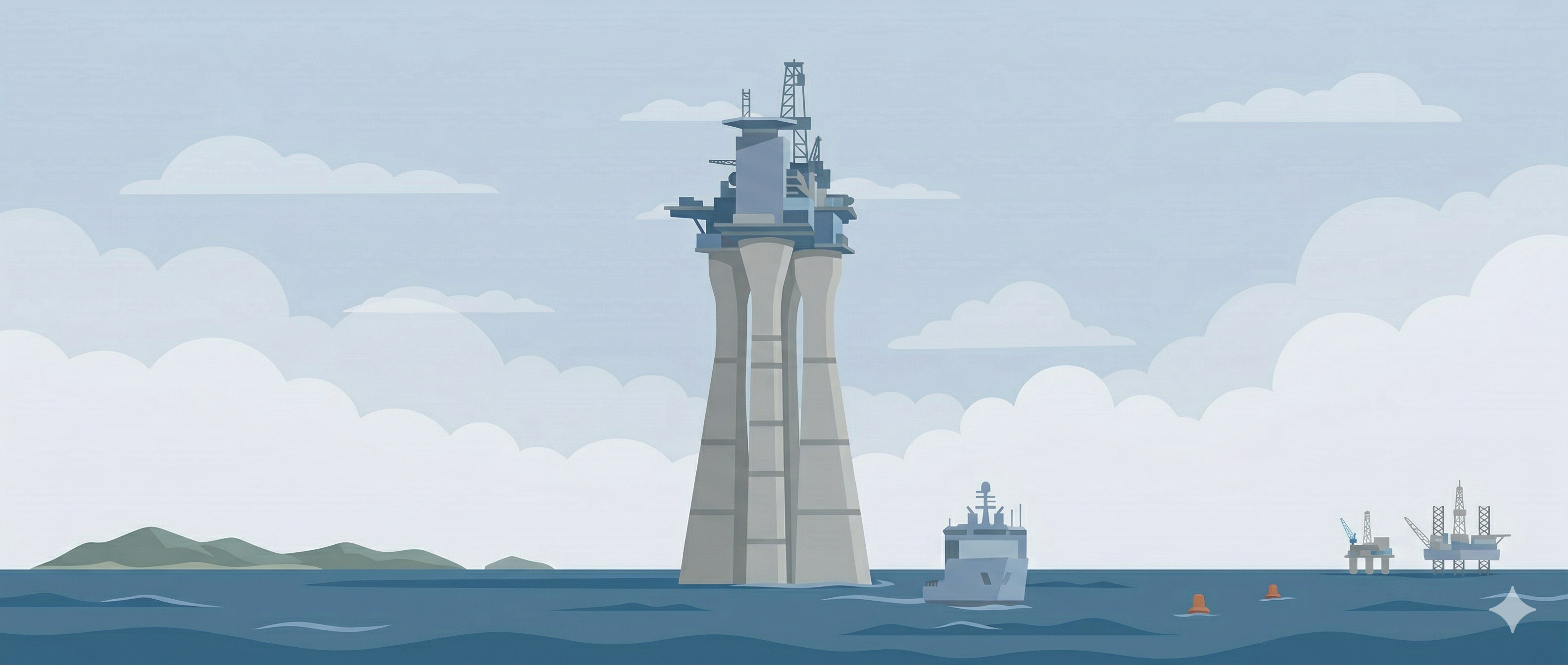
Arv Energy is innovating nuclear power plant design for constructability, leveraging Norwegian offshore industry expertise to deliver reliable, clean energy for generations to come.
At COP28, world leaders pledged to triple nuclear capacity to ~1,200 GW by 2050. Delivering on this requires building at twice the pace of history's fastest sustained nuclear expansion. This creates extraordinary opportunities for new entrants in the nuclear EPC domain, and a construction approach that can deliver.
Note: The 1970s buildout started from a tiny base (~33 GWe) with simple early reactor designs. Today the fleet is already ~10× larger in absolute terms, meaning supply chains, workforce, and manufacturing capacity must also scale ~2× faster than they ever have. This creates a massive opportunity for new entrants in the nuclear EPC domain with a construction design ready to scale.
The fastest sustained nuclear buildout ever achieved, starting from a ~33 GWe base with early reactor designs.
Needed to reach 1,200 GWe by 2050 — exactly 2× the historical peak rate, from a 10× larger starting base.
Supply chains, workforce, and manufacturing must all grow faster than in the 1970s, creating a massive demand for EPC competence.
The world has built ~400 GWe of nuclear capacity over 70 years — by a small group of specialist contractors. The COP28 tripling pledge requires ~800 GWe of new capacity in just 25 years — roughly double the peak historical build rate (1972–1989), sustained for a quarter century. Even if every existing nuclear EPC replicates its entire historical deployments, they will only cover ~57% of that target.
Hover markers to see company details. Circle size = historical GWe built.
Source: IAEA PRIS, WNA, company reports. Compiled March 2026.
If each EPC replicates its entire historical build once more by 2050.
Even if every established nuclear EPC contractor replicates its entire construction history within the next 25 years, the world still falls 345 GWe short of the COP28 tripling target. That gap must be filled by someone.
Nuclear's capacity problem isn't a technology problem — it's a construction problem, in which O&G EPCs has the supply chains and much of competences needed.
The gap isn't capability — it's qualification. Delivering multi-discipline projects in the $10s under extreme schedule and safety pressure is something O&G companies do every day.
Managing multi-billion dollar timelines with precision logistics and risk mitigation protocols.
Off-site fabrication and yard-based assembly models perfected in offshore construction.
Migrating 'Zero Harm' offshore mindsets to stringent nuclear quality assurance requirements.
Utilizing existing high-spec supply corridors for non-nuclear safety component sourcing.
We're taking a nuclear plant construction approach that the O&G industry can build, not one it has to adapt to.
The NNC concept combines offshore fabrication logic with proven reactor technology, using Nordic yards as the production backbone. Same workforce and proven methods in a new domain.
Modules fabricated in yards in parallel to required civil construction on-site, shrinking the construction window. Modules are then barged and heavy-lifted to site.
The Nordics have deep-water yards, heavy-lift capacity, and an industrial workforce that already builds large offshore & onshore structures. Paired with the coastal nuclear power plant sites that infrastructure is the backbone of the NNC concept.
We value conventional, reactor designs that leverages economics of scale, ensuring nuclear energy can live up to its promise of a cheap, abundant and clean energy source. The innovation is in how we build, not what we build.
Interested in learning more about what we do, or exploring collaboration opportunities? We'd love to hear from you.
Occasional updates on the nuclear construction market, Nordic industry developments, and Arv Energy progress.